
Jack Reacher arrives with a toothbrush and no plan, which is roughly how the series treats its own chronology. Lee Child published Killing Floor in 1997 and then spent nearly thirty years writing forward, backward and sideways through Reacher's life, dropping army prequels in whenever it suited. Here is every novel in the order it was published - which, unusually for a series like this, is also the order we think you should read them in.
Editor's Picks
- Killing Floor - reacher steps off a bus in small-town Georgia and is arrested for a murder committed the night before he arrived
- Persuader - back to first person after a run of third, and it is the better for it
- The Enemy - new Year's Day 1990, the Berlin Wall down and Reacher still a serving major
- 61 Hours - a bus crash strands him in a South Dakota town in deep winter, with a witness to protect and a clock running
- Make Me - and finds out why nobody else does
- The Midnight Line - a West Point class ring in a pawn shop window, and he decides to find out how it got there
Publication or chronological? The honest answer
Publication order. That is the whole answer, and it is worth saying plainly because it is the opposite of the advice we give for most series.
Reacher has no arc in the way a detective series usually does. He arrives in a town with a toothbrush, sorts out something violent, and leaves. Almost nothing carries between books, so the usual argument for chronological order - that you follow a life as it is lived - barely applies here.
The argument against it is stronger. Three of the novels are prequels set during his years as a military policeman, and all three lean on you already knowing the man he becomes. The Enemy is a good book on its own and a much better one after six or seven of the drifter novels, because the whole pleasure is watching a Reacher who still has a rank, an address and something to lose.
Read them as published and the prequels land as intended, dropped in like flashbacks. Read them chronologically and you spend your first four books with a character the author had not finished inventing.
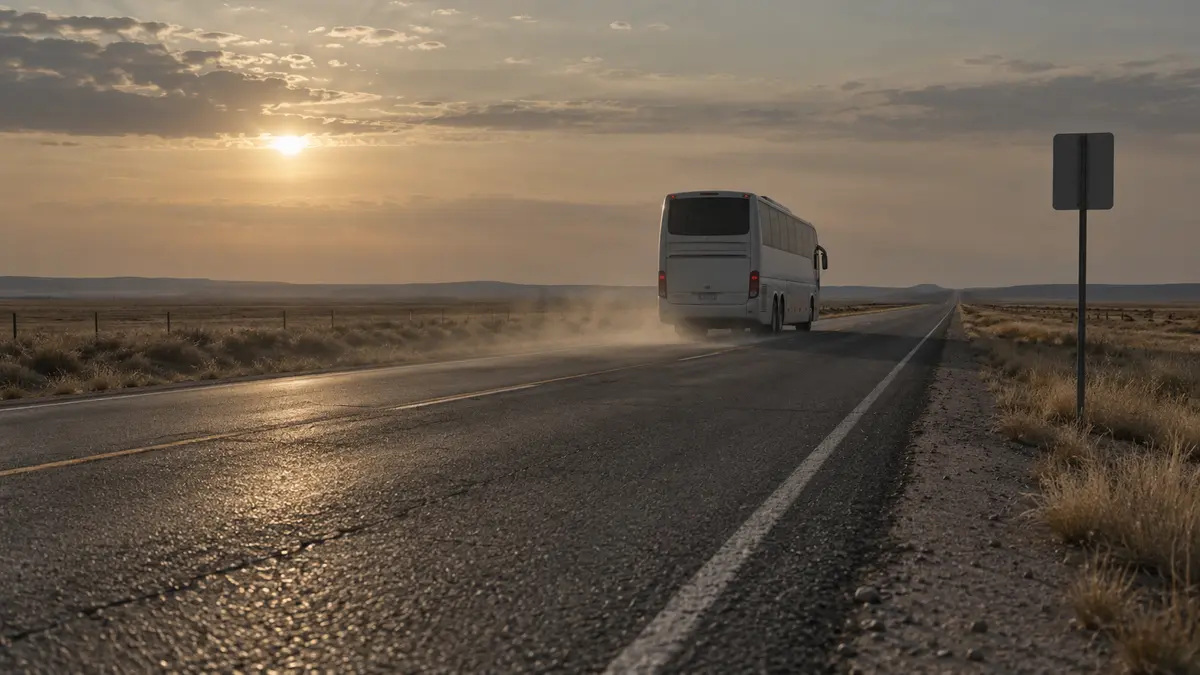

A coach that does not wait, and one set of prints walking away from it. The series has never needed more setup than that.
The four phases of the series
Thirty-one novels across nearly thirty years, and they fall into four clear blocks. Each has a different temperature, and each one can be started cold.
1997 to 2003 - the lean first-person years
Seven novels, most of them narrated by Reacher himself, and the reason people fall for the series. Short sentences, enormous restraint, and a man who is genuinely unknowable because we only ever hear what he chooses to tell us. Start with Killing Floor if you want the series as it was first read.
2004 to 2013 - the middle run, and the first prequels
The books move mostly into third person and settle into the shape everyone recognises: a town, a wrong, a countdown. It is also where the army prequels begin, dropped in between the drifter novels. The most consistently good stretch in the series, and it contains 61 Hours, the tightest of the lot.
2014 to 2019 - late Lee Child
Bigger canvases, more international, and a distinctly more elegiac Reacher who notices he is getting older. The Midnight Line is the one people underrate. Blue Moon in 2019 is the last novel Lee Child wrote alone.
2020 onwards - the Andrew Child era
From The Sentinel the books carry both brothers' names, and Andrew has since taken over the writing entirely. Faster, more externally plotted, and thinner on the interior voice that made the early novels strange. Perfectly good thrillers. Not where to start.
Where the prequels actually sit
If you do want the internal chronology, it runs roughly like this. The Enemy is New Year's Day 1990. Night School is 1996. The Affair is 1997 and is the case that ends his career, finishing days before Killing Floor begins.
That last pairing is the one genuinely useful piece of chronology in the series. Plenty of readers go back and read The Affair straight into Killing Floor after finishing the first dozen, and it works well.
Nine books, if you are not going to read all thirty-one
Nobody needs to read every one. These nine cover the whole arc - the lean early novels, the peak of the middle run, the best of the prequels and the late high points - and any of them works as a first Reacher.
 01
01Killing Floor
Reacher steps off a bus in small-town Georgia and is arrested for a murder committed the night before he arrived. First person, very lean, and it lays out everything the series will do. The honest starting point.
 02
02Persuader
Back to first person after a run of third, and it is the better for it. An undercover job on the Maine coast with a genuine grudge underneath, and the most personal Reacher gets in the early books.
 03
03The Enemy
New Year's Day 1990, the Berlin Wall down and Reacher still a serving major. A proper investigation rather than a rampage, and the best of the prequels - though it lands harder once you know the civilian version of the man.
 04
04One Shot
A sniper, five dead, and a suspect who asks for Reacher by name. The plot that became the first Tom Cruise film, and a tighter piece of construction than the film suggests.
 05
05Bad Luck and Trouble
His old special investigations unit starts turning up dead and the survivors reassemble. The only book that gives Reacher people he actually owes something to, and it changes the temperature completely.
 06
0661 Hours
A bus crash strands him in a South Dakota town in deep winter, with a witness to protect and a clock running. The most tightly plotted book in the series, and the one to hand anyone who says the plots are all the same.
 07
07The Affair
Mississippi, 1997, and the case that ends his army career. It finishes days before Killing Floor begins, which makes it the one prequel genuinely worth reading back-to-back with another book.
 08
08Make Me
Reacher gets off a train because he likes the name of the town - Mother's Rest - and finds out why nobody else does. A slow, creeping, genuinely nasty one, and a late high point.
 09
09The Midnight Line
A West Point class ring in a pawn shop window, and he decides to find out how it got there. Slower, angrier and sadder than the usual, and the book that surprises people who thought they had the series worked out.


A diner at first light and a motel after dark - thirty-one novels move between the two, and Reacher never owns either.
The full Jack Reacher reading order
Publication order, with the year. The three army prequels are marked; everything else is Reacher on the road.
- 01Killing Floor1997The lean years
- 02Die Trying1998The lean years
- 03Tripwire1999The lean years
- 04The Visitor2000The lean years
- 05Echo Burning2001The lean years
- 06Without Fail2002The lean years
- 07Persuader2003The lean years
- 08The Enemy2004Prequel · 1990
- 09One Shot2005The middle run
- 10The Hard Way2006The middle run
- 11Bad Luck and Trouble2007The middle run
- 12Nothing to Lose2008The middle run
- 13Gone Tomorrow2009The middle run
- 1461 Hours2010The middle run
- 15Worth Dying For2010The middle run
- 16The Affair2011Prequel · 1997
- 17A Wanted Man2012The middle run
- 18Never Go Back2013The middle run
- 19Personal2014Late Lee Child
- 20Make Me2015Late Lee Child
- 21Night School2016Prequel · 1996
- 22The Midnight Line2017Late Lee Child
- 23Past Tense2018Late Lee Child
- 24Blue Moon2019Late Lee Child
- 25The Sentinel2020Andrew Child era
- 26Better Off Dead2021Andrew Child era
- 27No Plan B2022Andrew Child era
- 28The Secret2023Andrew Child era
- 29In Too Deep2024Andrew Child era
- 30Exit Strategy2025Andrew Child era
- 31Chain Reaction2026Forthcoming
When you finish the thirty
There is more Reacher than the novels. A dozen short stories and novellas exist, several of them prequels to the prequels - Reacher as a teenager, Reacher at West Point - and they are collected in No Middle Name, which is a far better buy than hunting singles one at a time.
Then there are the adaptations. The two Tom Cruise films took One Shot and Never Go Back; the Prime Video series started at the beginning and has worked forward since. Both are louder and warmer than the books, which is the honest reason readers argue about them.
After that you are into other authors, because Lee Child wrote very little outside the series. Orphan X by Gregg Hurwitz takes the same competent-loner engine and gives it a conscience and a phone number. Robert Crais, and his Elvis Cole and Joe Pike novels, is the other reliable answer - warmer and funnier without being any less dangerous.
And if what you actually liked was the flat, watchful interior voice rather than the fighting, go sideways instead: Mick Herron's Slough House books carry the same dry contempt for institutions and considerably better jokes.
Other reading orders and starting points
Long series are easier with a map. These are the running orders and starting points we keep for the authors readers ask about most.
Frequently Asked Questions
How many Jack Reacher books are there?
Thirty published novels, with a thirty-first, Chain Reaction, due in October 2026. There are also a dozen short stories and novellas. Lee Child wrote the first twenty-four alone; from The Sentinel in 2020 the books carry both his name and his brother Andrew's, and Andrew has since taken over the writing.
Do you need to read the Jack Reacher books in order?
No. Almost every book is a self-contained case, and Reacher arrives with no luggage and no history, which is precisely the point of him. Only 61 Hours and Worth Dying For run directly into each other.
Which is the best Jack Reacher book to start with?
Killing Floor, the first one. It is first person, it is lean, and it sets out the character completely. If you would rather test the series without committing, 61 Hours works as a standalone and is the better book.
Should I read the prequels in chronological order?
We would not. The Enemy, Night School and The Affair are all set during his army years, and they work far better once you already know the drifter he becomes. Read them where they were published.
Are the Andrew Child books as good?
Opinions divide, honestly so. The later books move faster and are more plot-driven; the interior voice that made the early ones distinctive is thinner. Plenty of readers do not mind. If you are starting out, start with the Lee Child run and decide for yourself.
Do the Jack Reacher films follow the books?
Loosely. One Shot became the first Tom Cruise film and Never Go Back the second; the Prime Video series began with Killing Floor and has worked through the novels roughly in order since. The books are colder and far more interior than any adaptation.
 Shelf 01
Fiction
Literary novels, contemporary storytelling and the books everyone's talking about.
Browse → Shelf 02
Crime & Mystery
Cosy crime, gritty thrillers and a good whodunnit for a wet afternoon.
Browse → Shelf 03
Nature & Countryside
Nature writing, walking, farming and the wild places - our house speciality.
Browse → Shelf 05
Cookery
Seasonal cooking, baking and the kitchen books worth the shelf space.
Browse →